Melbourne’s Trusted Experts in Automated Gates & Fencing – Residential, Commercial & Industrial Solutions.

Can You Install a Sliding Gate on a Sloped or Uneven Driveway?
Learn how sliding gates work on sloped or uneven driveways, the best gate options, motor requirements, safety features, and installation tips for Melbourne homes.
7/21/20266 min read
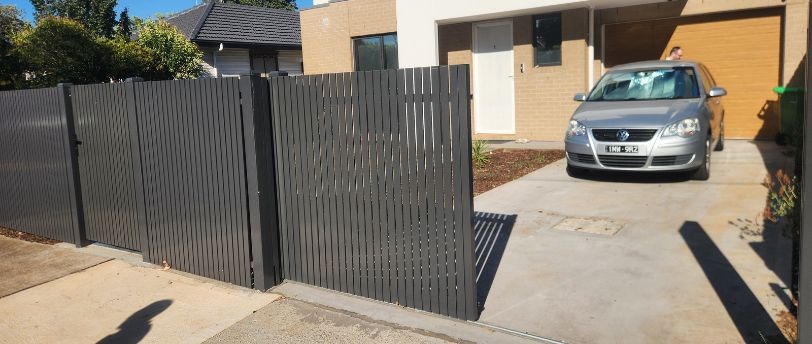
Melbourne has a lot of driveways that are not flat. Some rise up from the street, some dip down towards a garage, and some just have a bit of a lean from one side to the other. If your block is like this, you have probably wondered whether a sliding gate is even possible, or if you are stuck with something that will scrape, jam, or just look wrong.
Yes, you can install a sliding gate on a sloped or uneven driveway. It is actually one of the more common jobs we get asked about. A slope does change a few things about how the gate is built and set up, so it helps to know what those things are before you get quotes.
Why a Slope Changes the Way a Gate Behaves
A gate on flat ground is fairly simple. It sits level, it moves in a straight line, and gravity is not doing much to help or hurt it. Put that same gate on a hill and gravity gets involved. On the way down, the gate wants to roll faster than it should. On the way up, the motor has to push against its own weight the whole time. This is why a driveway with any real incline needs a bit more thought than a flat one.
Uneven ground adds a second layer to the problem. A driveway can slope from front to back, from side to side, or do a bit of both. Water also tends to collect in the low points, which can undermine posts and footings over time if it is not planned for. None of this means a gate is off the table. It just means the site needs to be measured properly before anyone starts fabricating anything.
Sliding Gates vs Swing Gates on a Slope
This is usually the first question people ask, so here is a quick side by side.
For most sloped driveways, a sliding gate is the more forgiving option. It travels parallel to the fence line instead of swinging into the incline, so there is no arc to worry about and no bottom rail catching on the rise or fall of the ground.
What Actually Happens to a Sliding Gate on an Incline
A slope does not stop a sliding gate from working, but it changes a few practical things you need to plan for.
The gate needs more clear space to slide into than it would on flat ground, because the track has to be built with the slope taken into account.
The motor has to work harder going uphill and needs to resist the gate speeding up going downhill.
A basic motor built for level ground can wear out fast on an incline, so the motor rating matters more here than on a flat site.
Drainage under the track needs attention, otherwise water pools around the base and causes rust or footing movement over time.
Safety matters more on a slope, since a heavy gate rolling downhill on its own is a real hazard if the power cuts out or someone releases it manually.
That last point is the one people miss the most. On a flat driveway, a gate that is not powered just sits there. On a slope, it can roll.
Getting the Track and Motor Pad Right
A lot of people get this part wrong, so it is worth explaining properly. The track that the gate rides along is usually built to follow the same angle as the driveway. If the driveway rises two degrees over its length, the track rises with it. This keeps the gate sitting flush and looking natural rather than floating oddly above the ground at one end.
The motor mounting pad works differently. It almost always needs to be poured level, regardless of what the ground around it is doing. This is because the motor's gear has to line up precisely with the rack on the gate, and that alignment only works if the motor itself is sitting flat. A good installer will usually raise the pad slightly too, so rainwater runs away from the motor housing instead of pooling around it.
When the Slope Is Too Steep for a Standard Sliding Track
Some driveways have a slope that is a bit much for a standard track and wheel setup. In these cases there are still a few ways to get a working gate.
Cantilever gates hang from rollers fixed to posts instead of running on a ground track, so there is nothing at ground level to catch uneven ground or debris.
Twin sliding gates split into two smaller panels that meet in the middle, which also removes the need for a ground track and suits driveways where the surface is genuinely uneven.
A custom-sized gate panel can be fabricated with the height and bottom edge built to match your driveway's slope, so the gap under the gate stays even along its whole length instead of widening at one end.
Any of these can work well, but they do need a proper site look before anyone commits to a design. What suits a steep block in Greensborough might not suit a gentle slope in Coburg.
Getting the Automation Right
The moving parts matter just as much as the gate itself when there is a slope involved. Gate automation on an incline usually includes a few extras that a flat site would not need.
A braking device that stops the gate rolling downhill on its own, almost like a handbrake, if the power cuts out.
A motor sized for the slope, not just the gate weight, since an incline can make a gate act much heavier than it actually is.
Soft start and soft stop settings, so the gate eases into movement instead of jerking, which reduces strain on the motor over time.
Safety sensors along the travel path, since a gate on a slope can pick up more momentum than one on flat ground.
Battery backup, so the gate still has controlled power during an outage rather than relying purely on manual release.
None of this is complicated once it is set up properly. It just needs to be part of the plan from the start rather than added on afterwards.
What to Check Before You Get Quotes
A few things are worth measuring or noting before an installer even comes out, since it speeds up the whole process.
The direction of the slope, front to back or side to side, and roughly how steep it feels.
How much clear space runs alongside the driveway for the gate to slide into.
Whether water already pools anywhere near where the gate line would sit.
Whether the driveway surface itself is level enough for a track, or whether it will need reworking first.
Most of this does not need any special tools. A rough estimate is enough to start the conversation, and a proper site visit will confirm the rest.
Getting Your Sloped Driveway Gate Right the First Time
A sloped or uneven driveway is not a reason to give up on a sliding gate. It just means the track, the motor, and the safety hardware all need to be matched to the site rather than picked off a generic list. Get those three things right and the gate will run smoothly for years, slope or no slope. Get them wrong and you end up with a gate that strains its motor, drifts on its track, or worse, becomes a safety risk when the power drops out.
If you have a sloped or uneven driveway in Melbourne and want an honest read on what will work, get in touch with our team for a site assessment. We will walk the block with you, measure the slope properly, and tell you straight what gate and motor setup actually suits your driveway.
Frequently Asked Questions
Can a sliding gate really work on a steep driveway?
Yes, in most cases. A cantilever gate is often the better choice on steeper grades since it has no ground track to catch on the incline, but a standard sliding gate can also work with the right track angle and motor.
Do I need a bigger motor for a sloped driveway?
Usually, yes. A motor rated for flat ground can lose a large amount of its capacity once it is working against a slope, so motors for inclines are generally sized specifically for the angle and weight involved.
3. What stops a sliding gate from rolling downhill on its own?
A braking device fitted to the motor system, which holds the gate in place if the power goes out or someone releases it manually. On any real incline, this is worth treating as a must, not a nice to have.
4. Will a swing gate work on my sloped driveway instead?
It depends on the direction of the slope. A swing gate can sometimes work on a mild side to side slope with rising hinges, but it usually struggles on a front to back slope because the bottom rail can scrape the ground as it arcs open. Swing gates tend to suit flatter blocks better.
5. How much extra space do I need beside a sloped driveway for a sliding gate?
More than you would need on flat ground, since the slope affects how the gate sits on the track and how much room the motor and safety hardware need. It varies by site, which is why a proper measurement matters more than a general rule of thumb.
Address : 22 Barkly St, Brunswick East VIC 3057, Australia
Connect With Us On Social Media
I Gate Automation
ABN 25 634 531 231
Our Privacy Policy
Our Terms & Conditions
Contacts
1300 251 900
info@igateautomation.com.au