Melbourne’s Trusted Experts in Automated Gates & Fencing – Residential, Commercial & Industrial Solutions.

How Automated Gates Improve Safety for Families with Children and Pets
Learn how automated gates improve safety for children and pets with auto-close features, sensors, and secure access for Melbourne family homes.
7/6/20265 min read
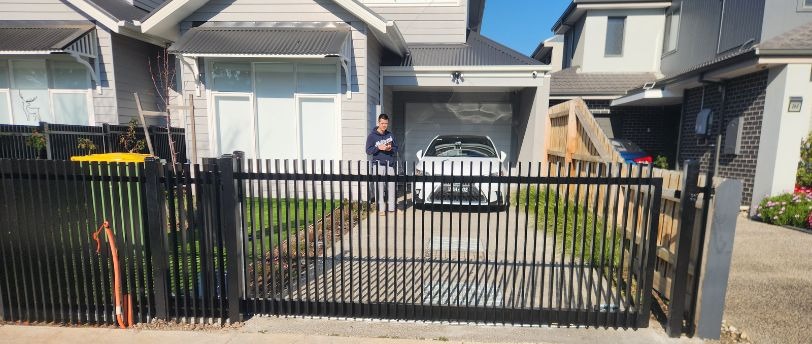
If you have young kids or a dog that likes to test the boundaries of your yard, you already know how quickly things can go wrong. A gate left open for two minutes is all it takes for a toddler to wander toward the driveway or a dog to bolt onto the street. This is one of the main reasons Melbourne families are moving away from manual gates and looking into gate automation for their homes.
Automation does one thing differently from a manual gate. It closes on its own, so nobody has to remember to do it. For a family with kids or pets, that ends up mattering more than the convenience of not getting out of the car in the rain, which is usually what gets mentioned first.
The Problem With Manual Gates
Most people do not think about their gate until something happens. Manual gates work fine in theory, but in real life they fail in predictable ways. A latch that seemed secure when it was first installed can loosen after a year or two of daily use, and nobody notices until the gate swings open on its own during a windy afternoon.
The bigger issue is habit. Families get busy, and a gate becomes one more thing to remember among school runs, work calls, and everything else that happens before 9am. It only takes one distracted moment for the gate to stay open longer than it should.
Someone leaves the gate open after bringing in groceries or taking out the bin.
Kids figure out how to lift the latch once they are tall enough to reach it.
Visitors or tradespeople forget to close the gate behind them.
Wind blows a lightweight gate open if the latch is not seated properly.
Pets learn the timing of when the gate is likely to be open.
None of these are unusual mistakes. They are just what happens when a safety feature depends on a person remembering to use it correctly, every time, without fail.
How an Automated Gate Closes That Gap
The core idea behind gate automation is simple. The gate defaults to closed. It only opens when someone with the right remote, keypad code, or app access tells it to, and it can be set to automatically shut again after a short delay. Nobody has to remember to do anything.
For a family with small children, this matters because kids do not wait for a good moment to run outside. An automated gate does not care whether anyone is watching the yard at that moment. It stays shut on its own, which means the space between your front door and the street stays a controlled zone rather than an open one. The same logic applies to dogs and cats. A pet does not need much of a gap to get through, and a self-closing gate removes that gap almost entirely.
Safety Features that Actually Protect kids and Pets
Not every automated gate is built the same way, and the features that matter for a family are not always the ones that get talked about most. Here are the ones worth asking about.
These features are standard on most of the systems we install through automatic security gates, so it is worth confirming which ones are included before you commit to a quote.
Choosing a Gate Style That Suits Your Yard
The type of gate you pick affects how well it does its job around kids and animals. Sliding gates tend to suit smaller driveways or blocks with a slope, since they do not need clearance space to swing open. They also keep the full width of the opening clear at all times, which some families prefer if pets like to sit near the fence line.
Swing gates work well on wider driveways and can be set up as a single or double gate depending on how much space you have. Either option can be paired with a pedestrian and side gate for a smaller, separate entry point that is used more often than the main driveway gate. Having a dedicated pedestrian gate also means the big driveway gate is not being opened and closed constantly just for someone walking in or out, which cuts down on the number of times it is left ajar.
Materials That Hold Up to Daily Family Life
A gate is only as safe as the material it is built from. Aluminium is a common choice for family homes because it does not rust, does not splinter, and does not develop the sharp edges that older timber or untreated steel gates can get over time. It also holds up well against the kind of daily bumps that come with kids on bikes or a dog leaning against the fence.
Steel is the stronger option where extra security is the priority, such as larger properties or gates that face a busy road. Whichever material you choose, it is worth pairing the gate with matching aluminium and steel fencing so there are no weak points elsewhere along the boundary. A strong gate does not achieve much if the fence next to it has gaps a small dog can slip through.
Keeping The System Running Properly
An automated gate is only as reliable as its motor and sensors. Salt air, dust, and general wear can affect how well the safety beams and auto-close function work over time, especially on older systems. If you notice the gate hesitating, closing too fast, or not reversing when something is in the way, it is worth getting it looked at rather than waiting for it to fail completely.
A check every six months is usually enough to catch small issues before they turn into safety problems. Dirty sensor lenses, worn hinges, and slow motors are common and easy to fix if they are picked up early. Regular checks through a service like electric gate repairs keep the safety features doing what they are supposed to do, which matters more here than with almost any other part of the property.
A Safer Yard Starts With a Gate That Does Its Job Automatically
An automated gate takes one of the biggest daily risks for families and turns it into something that runs in the background without anyone needing to think about it. It will not replace supervision, but it does close the gap that a manual gate leaves open, and that small change is often what stops a bad afternoon before it starts.
If you are weighing up your options for a Melbourne property, our team can walk you through which gate style, material, and safety features suit your household best. You can also check our frequently asked questions page if you want more detail before reaching out for a quote. If you are thinking about installing an automated gate or upgrading your current one, contact iGate Automation. Our team can help you choose a gate that suits your home, your budget, and your family's needs.
Frequently Asked Questions
Are automated gates safe for children?
Yes. Most automated gates have safety sensors that stop or reopen the gate if a child is in the way. This helps lower the risk of accidents. Regular servicing also keeps these safety features working properly.
Can an automated gate stop my dog from running out?
Yes. An automated gate closes by itself after someone enters or leaves. This makes it much harder for dogs and other pets to get out onto the street.
Will my gate work if the power goes out?
Many automated gates come with a backup battery, so they can still work during a power outage. If there is no backup battery, you can usually open the gate by using the manual release.
Which type of automated gate is best for a family home?
It depends on your property. Sliding gates are a good choice for smaller driveways or sloping land. Swing gates work well for wider driveways. Both types can be fitted with safety features for children and pets.
How often should an automated gate be checked?
It is a good idea to have your gate checked every 6 to 12 months. Regular servicing helps keep the motor, sensors, and other parts working safely and can prevent bigger problems later.
Address : 22 Barkly St, Brunswick East VIC 3057, Australia
Connect With Us On Social Media
I Gate Automation
ABN 25 634 531 231
Our Privacy Policy
Our Terms & Conditions
Contacts
1300 251 900
info@igateautomation.com.au