Melbourne’s Trusted Experts in Automated Gates & Fencing – Residential, Commercial & Industrial Solutions.

5 Reasons Your Automatic Gate Is Opening and Closing on Its Own
Is your automatic gate opening and closing by itself? Here are the 5 most common reasons and what you can do to fix it.
7/1/20266 min read
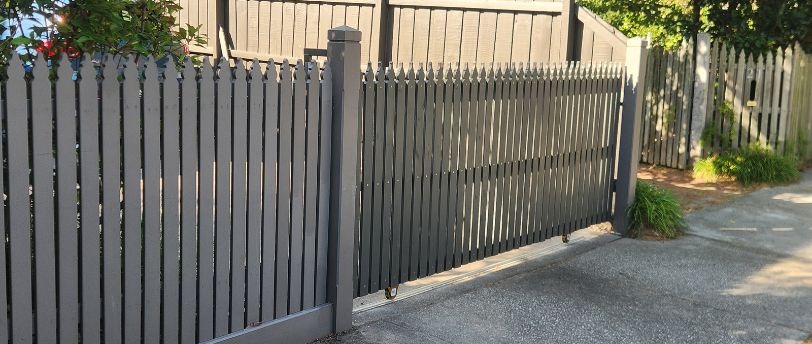
A gate that moves on its own is a strange thing to watch. It can also be a safety risk, especially if you have kids, pets, or cars near the driveway. If your gate keeps opening or closing without anyone touching a remote, something in the system is not working the way it should.
This kind of fault almost always comes back to one of a handful of causes. It is rarely one big fault. Usually it is a small thing that has been building up for weeks. Below are the five reasons we see most often at properties around Melbourne, along with what tends to fix each one.
How These Gates Actually Work
An automatic gate is really a small network of parts that all need to agree with each other. The remote sends a signal, the receiver picks it up, the sensors check the path is clear, and the control board tells the motor what to do. If one part in that chain gives a wrong reading, the whole system can act on it.
That is why a gate opening on its own is not really random. It is the gate reacting to a signal or fault that came from somewhere in that chain. Some of these faults are easy to spot and fix in a few minutes. Others need someone to open the control box and have a proper look.
1. A Remote That Is Stuck or Wearing Out
This is one of the most common causes, and often the simplest to sort out. A remote left in a bag, under a car seat, or in a back pocket can get pressed by accident. That signal reaches the receiver and the gate opens, even though nobody meant to send it.
Older remotes wear out too. The button underneath can get soft or stay half pressed after years of use. This sends a weak but ongoing signal to the gate, which can make it open or close at odd times with no clear pattern.
How to check if this is the cause:
Take the batteries out of every remote in the house, one at a time
Watch the gate for a day after removing each one
If the movement stops after a certain remote is disabled, that one is faulty
Press the buttons gently and see if they feel soft or stay pressed in
If a remote is old or has been dropped a few times, it is often cheaper to replace it than to keep testing it.
2. Signal Interference From Nearby Devices
Most home gate systems in Australia run on radio frequencies like 433 MHz. That frequency band is shared with a lot of other household gear, including garage door openers, some baby monitors, and certain wireless alarms. When two devices sit close to the same frequency, one can end up triggering the other by accident.
This tends to show up more in busier streets or near units and townhouses, where several properties might have gate or garage systems close together. A new router, smart plug, or security camera installed nearby can also throw off an older system that had been working fine for years. Systems with fixed codes are more prone to this than newer ones with rolling codes, since the signal does not change each time it is used.
If your gate has been fine for a long time and only started acting up after new equipment went in nearby, interference is worth ruling out first. A technician can check what frequency the system is on and, in some cases, shield or reprogram the receiver to cut down on the overlap. This is a common check during electric gate repairs.
3. Dirty or Misaligned Safety Sensors
Photocell sensors are the small units mounted on either side of the gate, usually about knee height. Their job is to stop the gate closing if something is in the way. When these get dirty, knocked out of position, or damp inside, they can send the wrong reading to the control board.
A sensor that is slightly out of alignment might think something is blocking the path when there is nothing there. On the other hand, a sensor with a build up of dirt or a spider web across the lens can miss a real obstruction or send confusing signals back and forth. Gardening, mowing, wind, and even direct sun hitting the lens at certain times of day can all throw a sensor off.
What usually causes sensor faults:
Dust, dirt, or cobwebs sitting across the lens
Sensors bumped out of alignment by a mower, trailer, or storm
Moisture getting into the sensor housing after rain
A loose wire at the base of the sensor mount
A soft cloth over each lens and a check that both sensors are facing each other properly is worth doing before calling anyone out.
4. Wiring Faults or Moisture in the Control Box
Wiring problems are harder to spot because the fault is usually hidden underground or inside a sealed box. Cables run through conduit for years without issue, then start to break down from age, sun exposure, or even from rodents chewing through the insulation. A loose connection at the control board or water pooling inside a junction box can both send random signals that look like the gate has a mind of its own.
This shows up more often in older installations, or ones that were not wired to a proper standard to begin with. Melbourne's wetter months do not help either. If the strange behaviour tends to happen after rain, during humid weather, or right after a storm, that is a strong hint the wiring or control box needs checking. Left alone, a wiring fault can end up putting extra strain on the motor as well, so it is worth having someone look over the gate automation setup before it turns into a bigger repair.
5. Power Surges or a Control Board Nearing the End of Its Life
The control board is what reads every signal coming in from the remote and sensors, then decides what the motor should do. A power surge from a storm, a lightning strike close by, or even a fault somewhere else in the home's wiring can damage this board.
Once a board is damaged, it can start sending out its own commands with no input from a remote or sensor at all. This is often what is behind a gate opening at strange hours, like the middle of the night, with nothing around to trigger it. Boards also just wear out over time, particularly on systems that have been running for eight or more years.
A surge protector fitted near the board can reduce the chance of this happening again after a repair.
Working Through the Problem Step by Step
Start with the easy checks before assuming the worst. Pull the batteries from every remote, wipe down the sensors, and see whether the gate settles down once all remotes are out of action. That alone solves the problem in plenty of cases.
If the gate is still opening or closing on its own after that, it is worth getting someone to look at it properly rather than keep guessing. Beyond the annoyance, a gate that will not stay closed is a security gap and a safety risk for anyone walking or driving near it. Sliding and swing systems each have their own quirks depending on the motor fitted, so a technician who knows automatic sliding gates and swing gates will usually track down the cause faster than trial and error at home.
Sorting Out a Gate That Will Not Behave
A gate that keeps opening or closing on its own is usually telling you something in the system is off. It could be a stuck remote, a dirty sensor, or wiring hidden underground that has started to fail. Most of these faults are fixable once someone has a proper look, and catching them early tends to mean a smaller repair bill down the track.
If your gate has been acting up and you are in Melbourne, get in touch with I Gate Automation for an inspection and repair. Call 1300 251 900 or reach out through our contact page to book a technician.
Frequently Asked Questions
1. Why is my automatic gate opening by itself?
The most common causes are a faulty or stuck remote, radio signal interference, dirty or misaligned safety sensors, damaged wiring, or a failing control board. A technician can test each component to identify the exact cause.
2. Can a low remote battery make my gate behave unexpectedly?
A low battery usually won't cause a gate to open on its own, but a damaged or worn-out remote button can send repeated signals. If you suspect the remote, remove its batteries and monitor the gate to see if the problem stops.
3. Can weather affect my automatic gate?
Yes. Heavy rain, humidity, strong winds, and lightning can all affect gate performance. Moisture can damage wiring or sensors, while power surges during storms can harm the control board.
4. Is it safe to keep using a gate that opens and closes on its own?
No. A gate that moves unexpectedly can create safety risks for people, pets, and vehicles, while also leaving your property unsecured. It's best to stop using the automation if possible and arrange a professional inspection as soon as you notice the issue.
5. How can I prevent my automatic gate from developing this problem again?
Regular maintenance is the best prevention. Clean the safety sensors, replace worn remotes, inspect the gate for signs of wiring damage, keep the control box dry, and have the system professionally serviced every 12–24 months to catch small issues before they become major repairs.
Address : 22 Barkly St, Brunswick East VIC 3057, Australia
Connect With Us On Social Media
I Gate Automation
ABN 25 634 531 231
Our Privacy Policy
Our Terms & Conditions
Contacts
1300 251 900
info@igateautomation.com.au