Melbourne’s Trusted Experts in Automated Gates & Fencing – Residential, Commercial & Industrial Solutions.

Should Your Automatic Swing Gate Open Inward or Outward?
Inward or outward swing gate? Compare safety, space, slope, and council requirements to choose the best option for your property.
4/15/20265 min read
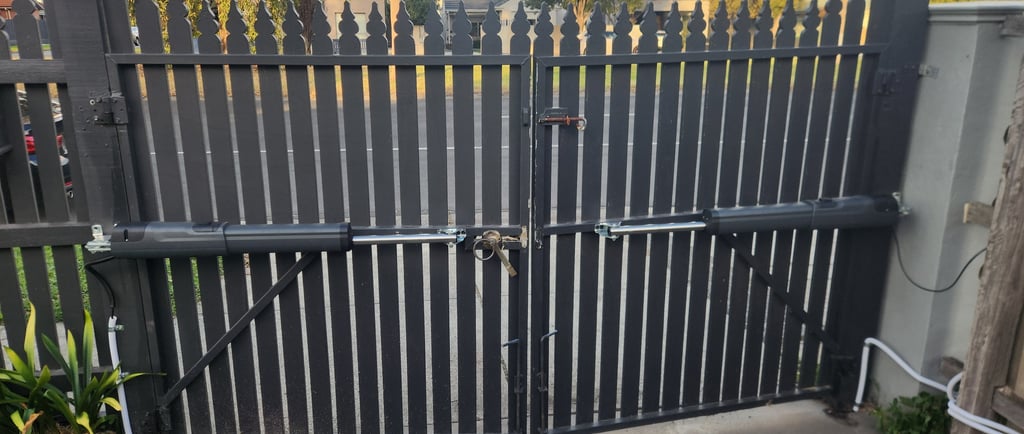
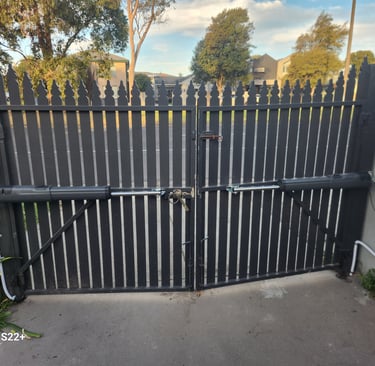
It sounds like a simple question. But if you get it wrong, you could end up with a gate that hits your car, blocks foot traffic, or just does not work properly with your automation system. The direction your swing gate opens matters more than most people think, and it is worth sorting out before you commit to an installation.
Most people don't realize that the choice usually depends on the layout of your driveway and how much room you have. You need to look at things like the slope of the ground and where you usually park your car. If the gate swings the wrong way, it might not even be able to open all the way. This guide walks you through the key things to consider so you can make a confident decision for your property.
Why Gate Opening Direction Actually Matters
When you are choosing an automatic swing gate, the opening direction affects a lot more than just looks. It shapes how the gate interacts with your driveway, your slope, your street, and the motor that drives it.
An inward-opening gate swings toward your property. An outward-opening gate swings toward the street or footpath. Both are common. But each one comes with its own set of rules depending on your site conditions, local council requirements, and the type of automatic gate opener you are using.
Inward vs Outward Opening: A Quick Comparison
Why Most People Pick Inward- Opening Gates
Most residential automatic swing gates in Australia open inward. There are a few good reasons for that. First, it keeps the gate on your side of the boundary. The gate swings into your driveway rather than out toward the street, which is generally safer for anyone walking past. It also keeps the automation hardware tucked inside the property, which helps with both security and weatherproofing.
The main thing to check is whether you actually have enough room. The gate needs a clear arc to swing open without hitting a car, a wall, or a garden bed. If your driveway is long and relatively flat, an inward opening usually works well. If you park right at the gate or have a steep upward slope, you need to measure carefully before deciding.
Why Most People Pick Inward-Opening Gates
Outward-opening gates are often chosen when the internal space is limited. If your driveway is very short or sits on a steep upward incline, there may simply not be enough room for the gate to swing inward without hitting a parked vehicle.
That said, outward opening does come with some restrictions you need to be aware of. In most Australian states, a gate that opens outward over a public footpath is not allowed without approval. Even where it is technically permitted, it creates a risk for pedestrians who may not see the gate starting to move. If you are considering outward opening, always check with your local council first and make sure the gate has proper safety sensors.
Checking the Hill or Slope of Your Driveway
Slope is one of the biggest practical factors in choosing swing gate direction. Here is a straightforward breakdown:
Flat driveway: Either direction works. Inward is usually preferred for safety reasons.
Upward slope (rising away from street): Inward opening can be tricky. The gate may drag on the ground as it swings up the incline.
Downward slope (falling away from street): Inward opening tends to work better here. The gate swings down into the driveway with the slope.
Cross slope (side to side): This is where you need to be most careful. A significant cross slope can put extra stress on the hinges and motor regardless of direction.
If your driveway has a noticeable slope, it is worth talking to an installer about whether a swing gate is even the right choice, or whether a sliding gate might suit your site better. Sliding gates handle slopes much more reliably in many cases.
Choosing the Right Motor For Your Gate
The direction your gate opens directly affects the type of motor arm you need and how it gets mounted. Most swing gate openers use an articulated or linear arm that attaches to the gate leaf and the post. The arm has to be positioned correctly for the direction of travel.
A few things worth knowing:
Arm length and geometry: The motor arm must be sized to match the gate leaf width and the opening angle. Getting this wrong affects how smoothly the gate operates.
Opening angle: Most residential swing gates open to around 90 to 100 degrees. If you need a wider angle, confirm your chosen motor supports it.
Dual leaf gates: Both leaves need motors, and they need to be programmed to open in sequence or simultaneously depending on your setup.
Safety beam placement: Sensors that stop the gate if something is in the way need to be positioned based on the swing direction. An inward-opening gate needs beams on the inside of the property.
If you are not sure what setup suits your gate configuration, the gate automation installation process should include a proper site assessment. A good installer will check all of this before recommending a system.
Council Rules and Boundary Setbacks
In Australia, most local councils have rules about where gates can open and whether they can extend over a public footpath or road reserve. These rules vary by council and by state, so you cannot assume what applies in one suburb applies in another.
Generally speaking:
Inward-opening gates rarely have compliance issues as long as they stay within your property boundary.
Outward-opening gates often require the gate to stop before it reaches the footpath. Some councils require a setback of at least half a metre from the boundary.
Heritage or body corporate properties may have additional rules about gate aesthetics or operation.
It is always worth checking before you install. A gate that opens the wrong way or extends over the boundary can result in an enforcement notice, and you may have to pay to have it reinstalled correctly.
Keeping Your Gate Safe for Everyone
Whether your gate opens in or out, safety features are not optional. Automatic swing gates are heavy and move fast enough to cause serious injury if something goes wrong.
Key safety features to look for:
Obstacle detection sensors: These stop and reverse the gate if something is in the path of travel.
Soft start and soft stop: Reduces mechanical stress and lowers the risk of impact injury.
Manual release: Allows the gate to be opened by hand during a power outage.
Auto-close timer: Ensures the gate does not stay open indefinitely, which is a security risk.
Pedestrian access mode: Some systems allow one leaf to open partially for foot traffic without fully activating both leaves.
For outward-opening gates in particular, sensors need to cover the area in front of the gate where pedestrians might be walking. This is a non-negotiable safety requirement.
A Quick Checklist Before You Decide
Before you lock in a gate direction, run through these questions:
How much clear space do I have on the inside of the gate?
Is my driveway flat, sloped upward, or sloped downward from the street?
Does my council allow outward-opening gates near the footpath?
Where will the motor arm and control box be mounted?
Do I need single or dual leaf operation?
Have I accounted for where cars typically park near the gate?
If you can answer all of these confidently, you are in good shape to move forward with an installation.
Picking the Right Gate for Your Home
There is no single rule for every driveway. The best choice for you depends on your space, your slope, and what your local council allows. For most homes in Australia, a gate that opens inward is the easiest and safest way to go. It keeps the motor hidden and stays inside your property.
If you are still not sure, the best thing to do is book a site inspection. A professional installer can look at your driveway and tell you exactly what will work best. It’s a simple step that saves you the stress of picking the wrong setup.
Address : 22 Barkly St, Brunswick East VIC 3057, Australia
Connect With Us On Social Media
I Gate Automation
ABN 25 634 531 231
Our Privacy Policy
Our Terms & Conditions
Contacts
1300 251 900
info@igateautomation.com.au