Melbourne’s Trusted Experts in Automated Gates & Fencing – Residential, Commercial & Industrial Solutions.

Sliding vs Swing Gates: Which Is Best for Your Property?
Compare sliding vs swing gates to find the best option for your property. Learn how space, slope, cost, security, and maintenance affect your choice before installing a driveway gate.
4/4/20266 min read
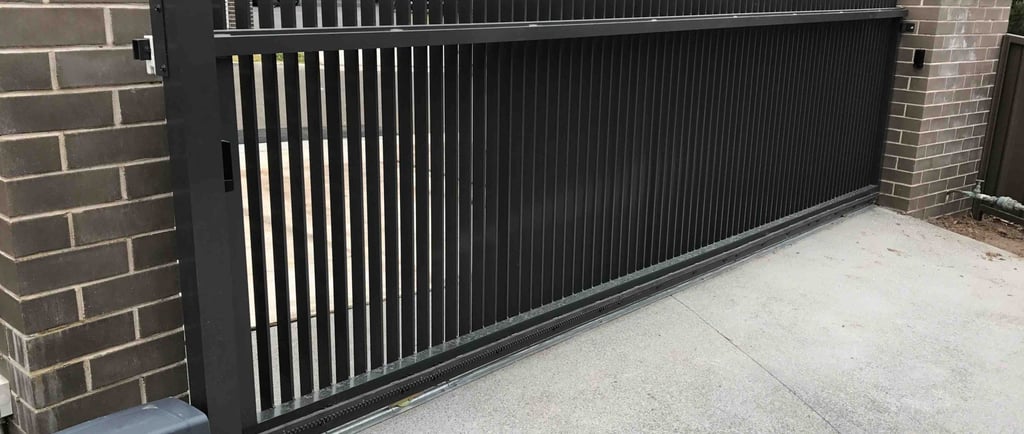
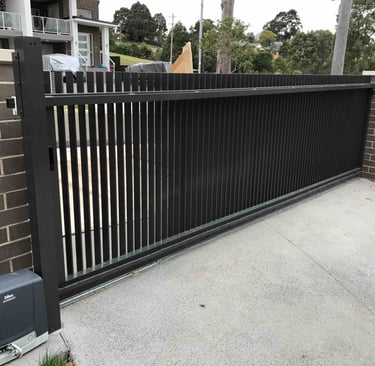
Sliding gates and swing gates are the two most common driveway gate types. Both open, both close, and both can be automated. But they are built differently and they suit different properties. Picking the wrong one usually means problems later, either with the motor, the space, or how the gate holds up over time.
This blog covers how each type works, where each one makes sense, and what to think about before making a decision.
How Each Type of Gate Works
A sliding gate moves sideways along a track. The gate panel sits on rollers and slides parallel to the fence line when it opens. It does not swing into your driveway or out toward the street. Once open, the panel sits to the side of the entrance and out of the way.
A swing gate opens on hinges. It can open inward toward your property or outward toward the street. Swing gates come as a single panel or as a double panel where two gates meet in the middle. Double swing gates are common on wider driveways because the weight is split across two panels instead of one post carrying all of it.
Sliding Gates: Pros and Cons
Pros:
Space saving: No swing arc needed. Works well when there is not much depth between the gate and the garage.
Works on slopes: The gate runs along a track and is not affected by the incline. This is one of the main reasons sliding gates are common on sloped suburban blocks.
Handles wind better: The track supports the gate along its full length. Wind load is not concentrated on a single hinge or motor arm.
Harder to force open: The gate can only move in one direction. There is no pivot point to attack, and a locking pin holds it firmly in place.
Cons:
You need enough fence line space for the gate panel to retract fully. If a wall or corner sits close to the entrance, this becomes a problem.
The track collects leaves, dirt, and gravel. It needs regular cleaning or the motor works harder than it should.
Upfront cost is higher than swing gates. More components, more installation time.
Swing Gates: Pros and Cons
Pros:
Simpler to install: No track to lay, fewer mechanical parts, quicker installation. This keeps the upfront cost lower.
Suits flat, open driveways: If you have the space, swing gates are straightforward and reliable.
Traditional look: Works well on heritage or period-style homes where appearance matters.
Quieter operation: Generally run more quietly than sliding gates.
Cons:
Need clear room to swing open: Parked cars or obstacles behind the gate will stop it from opening fully.
Do not handle slopes well: On uneven ground, panels drag or bind and the motor works against gravity every cycle.
Large panels in strong winds put strain on the motor arm and hinges over time.
Outward opening swing gates near footpaths can create safety issues. Most local councils in Australia have rules around this.
The Factors That Actually Matter
Looks are secondary. What matters more is your driveway layout, your block's slope, how often the gate will be used, and what the weather is usually like in your area. These things directly affect how long the gate and motor last. A gate that looks great but was chosen without checking the terrain or the available space will cause problems inside the first year.
It also helps to think about how people use the property day to day. If vehicles are going in and out multiple times a day, motor durability matters more than cost. If foot traffic also needs access, many properties run a pedestrian and side gate alongside the main driveway gate rather than routing all traffic through one opening. That keeps wear on the main gate down.
Driveway Space and Layout
Measure your space before choosing anything.
Short driveway depth: If there is not much distance between your gate and where your car parks, go with a sliding gate.
Limited side space: If there is no fence line for the gate to retract into, a swing gate may be the only option.
Wide opening: For driveways wider than roughly four metres, double swing gates are often more practical than one large sliding panel.
Sloped driveway: On any kind of gradient, sliding gates are the better option. Swing gates on a slope cause ongoing motor and hinge issues.
Pedestrian access: If a walkthrough is needed next to the main gate, that uses up fence space that a sliding gate would need to retract into.
How Terrain Affects Your Choice
Swing gates need a flat surface to open properly. If the ground slopes toward the street or away from it, the panels drag or lift unevenly. On steeper gradients, the motor is working against gravity every time the gate moves. That causes faster wear on both the motor and the hinges.
Sliding gates do not have this problem. The track is installed level along the fence line and the gate rolls along it regardless of the driveway gradient. This is one of the main reasons sliding gates are common in Melbourne and other areas where suburban blocks sit on a noticeable slope. If your block has any kind of gradient, the terrain alone may decide the gate type for you.
Security: How the Two Types Compare
Sliding gates can only move along the track: A locking pin holds them in place and there is no hinge to attack. They are harder to force open.
Swing gates have hinges, which can be a weak point if the quality is low. Good quality hinges and a solid lock reduce this risk.
Both types can connect to intercoms, keypads, and access control systems. The level of gate automation you add will have a bigger impact on security than the gate type itself.
On commercial sites or properties with high vehicle traffic, sliding gates are the more common choice for both security and durability.
Costs and Maintenance
Swing gates cost less to install. The hardware is simpler and the installation is quicker. If your budget is tight and the driveway suits it, a swing gate is a reasonable choice. But lower upfront cost does not always mean lower overall cost. On a sloped block or in a windy location, a swing gate will need more maintenance and more frequent motor servicing.
Sliding gates cost more to set up because of the track and the installation involved. But they hold up well under heavy use. If the gate is running multiple times a day, the sliding gate is usually the better investment over time. Maintenance is mostly keeping the track clear of debris, which is simple. For either type, pairing the gate with consistent aluminium and steel fencing around the rest of the property means you are working with matching materials that hold up at a similar rate.
Quick Guide: Sliding vs Swing Gates
Go with a sliding gate if:
Your driveway is on a slope
Depth is limited but side space is available
The gate will be used frequently
Security is a priority
You are in a windy area
Go with a swing gate if:
The driveway is flat with plenty of swing clearance
Upfront cost is a concern
The gate will be used occasionally
You prefer a traditional aesthetic
The Right Gate Comes Down to Your Block, Not a Preference
Both gate types work well when they are matched to the right property. The issues start when the wrong type is installed and the terrain or layout works against it from day one.
Before deciding, measure your driveway depth and your available fence line. Check the slope. Think about how often the gate will open and close. Those answers will narrow it down quickly. Most properties have a clear fit once you look at the actual layout rather than just the price or the appearance. Choose based on what the property needs, not what looks good on paper. For more advice on choosing the right gate or to get a quote for your property, contact the experts at iGate Automation today.
Frequently Asked Questions
1. Can any gate be automated?
Most existing manual gates can be retrofitted with an automation system, provided the frame is structurally sound and the hinges or tracks are in good condition. However, the type of motor required will depend on the gate's weight, length, and how often it will be used.
2. Which gate type is more secure?
Generally, sliding gates offer higher security. Because they are held in place by a channel and a post, they are much harder to force open or "kick in" compared to a swing gate, which relies entirely on the strength of the hinges and the motor arm.
3. How much side room do I need for a sliding gate?
To install a sliding gate, you need a clear, straight run of fence line that is slightly longer than the width of the driveway itself. For example, if your driveway is 4 metres wide, you will typically need about 4.5 to 5 metres of side space to allow the gate to retract fully.
4. Are swing gates okay for windy areas?
Swing gates act like large sails; in high winds, the pressure on the motor and hinges can be immense, sometimes preventing the gate from closing properly. If your property is in a high-wind zone, a sliding gate or a "slatted" swing gate (which allows air to pass through) is a much safer choice.
5. Do I need a track for a sliding gate?
Most sliding gates require a metal track installed across the driveway. However, if your driveway is unpaved or has a surface that makes a track difficult, you might consider a cantilever gate. These slide sideways like a standard gate but are suspended off the ground, requiring no track across the opening.
Address : 22 Barkly St, Brunswick East VIC 3057, Australia
Connect With Us On Social Media
I Gate Automation
ABN 25 634 531 231
Our Privacy Policy
Our Terms & Conditions
Contacts
1300 251 900
info@igateautomation.com.au